

















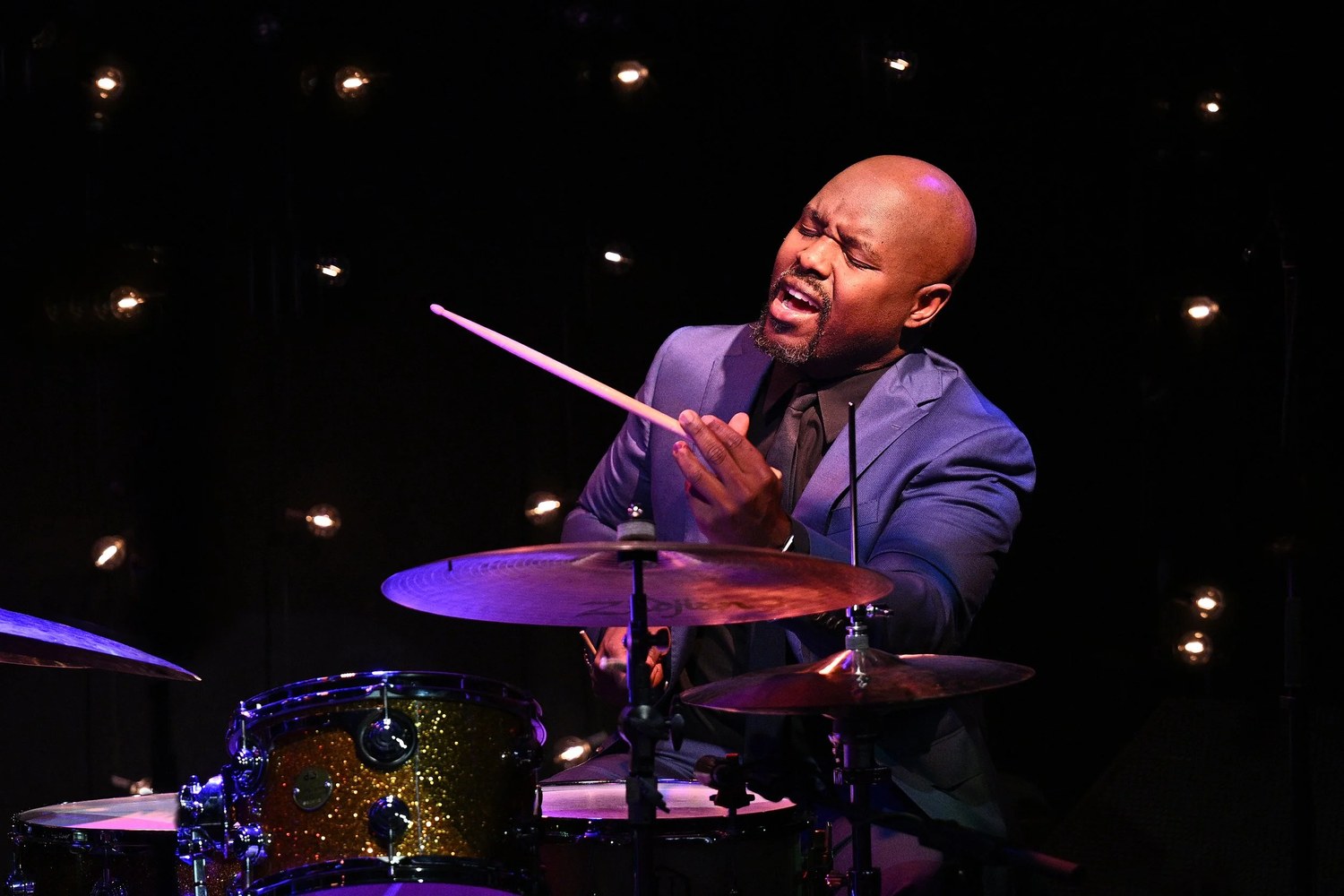
Ulysses Owens
Jazz
About
Ulysses Owens Jr. is a three-time GRAMMY Award-winning jazz drummer, bandleader, producer, educator, author and composer. He leads Generation Y and The People’s Big Band, heads UOJ Productions, teaches at The Juilliard School and The New School, and serves as Drumeo’s inaugural Jazz Drum Instructor and Founding Artistic Director of Jacksonville nonprofit Don’t Miss a Beat. Through UOJ Productions, he has produced more than 70 albums in 15-plus years.
The New York Times has called Owens “a drummer who takes a back seat to no one.” He has performed or recorded with Christian McBride, Kurt Elling, Wynton Marsalis, Mulgrew Miller, Renée Fleming and Dianne Schuur, and has appeared on GRAMMY-winning albums by Elling, the Christian McBride Big Band and the Generation Gap Jazz Orchestra. His big band earned DownBeat’s Rising Star Large Ensemble honor in 2022; Modern Drummer readers named him Jazz Drummer of the Year in 2024; and Generation Y’s A New Beat spent eight consecutive weeks at No. 1 on the JazzWeek Radio Chart.
“I want to be known as a trailblazer, and as a person who has his hand on the pulse of what’s next in every way,” Owens says. “I want to be known as a guy that echoes the past, but I’m firmly planted in the present, and I’ve also got my hand very much on the future of whatever is going to be next. I’ll be smack dab in the middle of it, even if I’m 80 years old.” He found an early model in Quincy Jones, whose autobiography he read at 18. “This guy was at the precipice of every era, and I want to be that.”
Owens was born December 6, 1982, in Orange Park, Florida, near Jacksonville. His mother directed choirs and sang in church; his father devoured everything from the Crusaders to Otis Redding and took Owens to the Jacksonville Jazz Festival. His cousin Kevin supplied jazz records and drummer videos. Owens grew up in the Church of God and started playing drums in church. His father built him a small cowbell setup so he could sit beside the drummer; as a young child, when that drummer left over a pay dispute, Owens became the drummer for the children’s choir and two adult choirs.
His parents enrolled him in classical piano lessons so he would learn to read music. In middle school, Owens tried to switch to saxophone and could barely make a sound. His band teacher, Miss Henley, handed him drumsticks and watched him play a funk groove and solo. “I want you to take that saxophone home and don’t you ever return with it again,” she told him. “You’re going to be my drummer.” Over the next three years, Henley taught him concert snare drum, mallet percussion and marching percussion. At Douglas Anderson School of the Arts, Owens joined the concert band and percussion ensemble and became the freshman drummer in its top jazz ensemble.
At 16, Owens visited New York and met drummer John Riley at Manhattan School of Music. Riley heard him play and told him, “If you want to play jazz, you don’t sound like a jazz drummer. You sound like a church drummer.” He sent Owens home with Miles Davis’ Milestones. On the record, Philly Joe Jones’ rudimental snare language sounded immediately familiar. “It was like hearing something, like I had been here before,” Owens says. He threw out his R&B and hip-hop records and decided, “I’m gonna learn this music, and I’m gonna dedicate my entire life to it.” He studied Art Blakey, Max Roach and Billy Higgins, then worked backward to Baby Dodds and Sid Catlett. Owens describes himself as “a traditionalist that’s rooted in the foundation and the evolution of the instrument and the art form of jazz drumming.”
The Juilliard Experience brought Owens back to New York. He liked the school’s intensity but did not want to study classical percussion; the following year, Juilliard announced its new Jazz Studies program, and Owens entered its inaugural class in 2001 at 18. He was one of only four 18-year-olds in a class filled largely with older players. “Life began at Juilliard,” he says. “I got baptized by fire. I realized that I didn’t know anything.” Victor Goines, the program’s first artistic director, became a key mentor. At Juilliard, Owens realized “it wasn’t enough to be a drummer. I needed to be a complete musician.”
Pianist Mulgrew Miller soon became his other central mentor. Miller approached Owens at a gig, corrected the way he was playing his ride cymbal and kept mentoring him as Owens came back with questions. Their relationship lasted until Miller’s death in 2013; Owens has called him a “second father,” and they spoke every week. Miller started hiring him while he was still at Juilliard, and as professional calls increased, Owens briefly considered leaving school. Drummer Marcus Baylor stopped him: “Get your degree. The road will always be there.” Owens stayed and earned his Bachelor of Music degree in Jazz Studies in 2006.
Upcoming shows
No upcoming events listed right now.